
The Evolution of Network Offload: Bridging the Gap Between Hardware Speed and Virtual Manageability
🖐🏼🥸 Taking a quick pause on Enhanced Data Path, let’s zoom out to the broader Network Offload category. Before diving into the specifics of Uniform Passthrough (UPT) and Enhanced DirectPath (calling it EDPIO to avoid confusion) in upcoming posts, it is helpful to understand the broader landscape—especially since all the Advanced NIC Passthrough options we will explore later are actually built on top of, and require, the EDP Standard fastpath.
Here is a look at how virtualized network architectures have evolved to balance hardware speed with the beloved VMware-grade manageability.
The Evolution of Network Offload: Bridging the Gap Between Hardware Speed and Virtual Manageability
Historically, network architecture in virtualized environments required choosing between raw hardware performance and day-to-day operational manageability. As high-performance NICs, GPUs, and AI accelerators have become standard in modern data centers, the necessity to offload packet processing and direct hardware access has grown.
Legacy Options: The Era of Huge Trade-offs
Earlier passthrough technologies provided near-bare-metal speeds but forced administrators to forfeit critical virtualization capabilities.
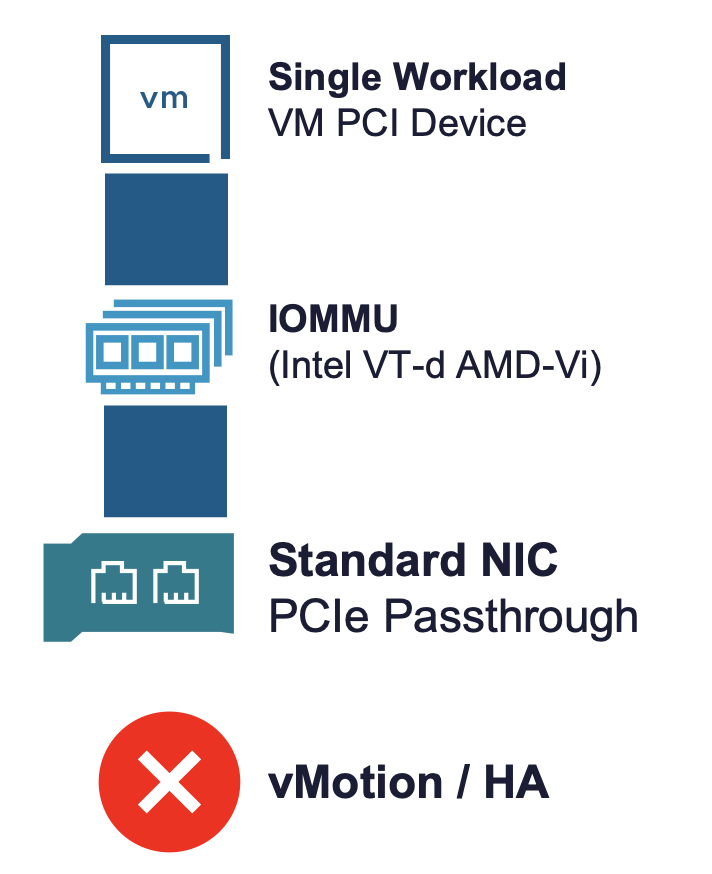
- DirectPath (PCI Passthrough): Introduced way back in vSphere 4.0, this legacy approach grants a single virtual machine exclusive access to a physical hardware component. While dedicating a full Physical Function (PF) to one workload guarantees exceptional performance, the cost is a total loss of workload mobility. Because the VM is essentially hard-wired to a specific physical address on the host, standard vSphere capabilities like vMotion and Suspend/Resume are off the table. If the physical host requires an update, the attached VM must go offline.
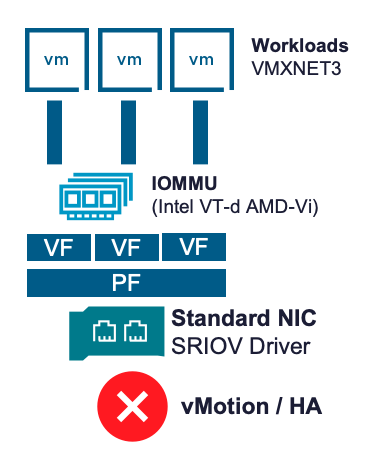
- Single-Root I/O Virtualization (SR-IOV): Arriving later in vSphere 5.1, SR-IOV successfully removes the limitation of dedicating an entire network card to just one VM by dividing a physical device into multiple Virtual Functions (VFs). You get the performance of passthrough with much better consolidation. Unfortunately, the operational roadblocks remain identical to traditional DirectPath. Tying a VM directly to a hardware VF means you lose the abstraction required for vSphere’s most valuable tools; vMotion is off the table, and host maintenance windows will inevitably require VM downtime.
Modern Options with DPUs: Hardware-Accelerated Packet Processing
With the launch of vSphere Distributed Services Engine (DSE)—a unified architecture requiring both vSphere 8 and the slightly out-of-sync NSX 4.0 release—packet processing can now be completely offloaded to dedicated Data Processing Units (DPUs) and their adjacent hardware accelerators.
- UPT with BlueField-2/3 (DPU) and AMD Pensando (DPU): This architecture leverages dedicated ARM cores on the DPU (such as the BF3 or Elba SNIC hardware flow engines) to handle network processing entirely off the primary host CPU.
The Hardware Reality: While this provides excellent security and compute isolation, it requires specialized investments. Organizations must procure purpose-built DPU servers natively; you cannot retrofit existing hardware, and OEM support is not universally available.
Handling Flow Misses: With DSE/SmartNIC-based passthrough, any traffic that cannot be processed by the hardware fast path (a “flow miss”) is routed to the DPU’s embedded ARM processor. This ensures the host CPU remains completely undisturbed, but it also means exception handling is bottlenecked by the compute profile of those embedded ARM cores rather than the beefier host system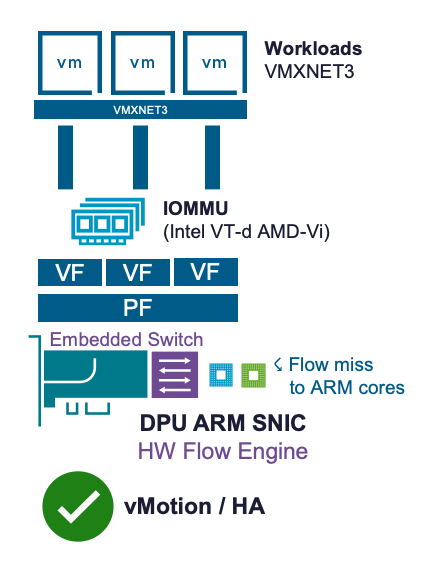
Advanced NIC Passthrough: Zero Compromises
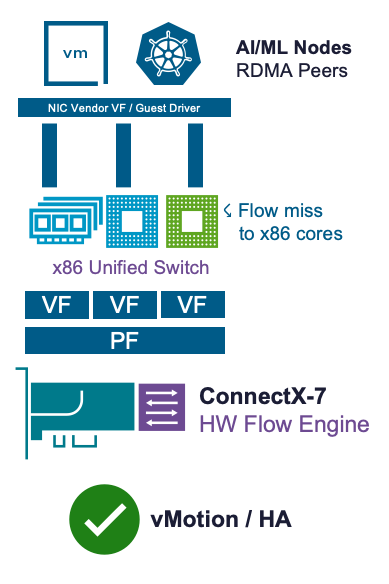
Modern vSphere architectures recognize that workloads shouldn’t have to choose between performance, manageability, and hardware flexibility. Available exclusively in VCF 9.1, Advanced NIC passthrough is our strongly recommended and preferred approach. It utilizes hardware flow engines on performance NICs to deliver direct hardware speed while preserving essential lifecycle management operations.
For environments demanding top-tier performance, this approach offers unmatched deployment flexibility. Unlike architectures that require purpose-built servers, Advanced NIC options allow organizations to easily retrofit their existing hardware fleets. By deploying compatible high-performance adapters like the ConnectX-7 into current servers, customers can maximize their existing infrastructure investments and accelerate deployment timelines without the requirement of a broader hardware refresh.
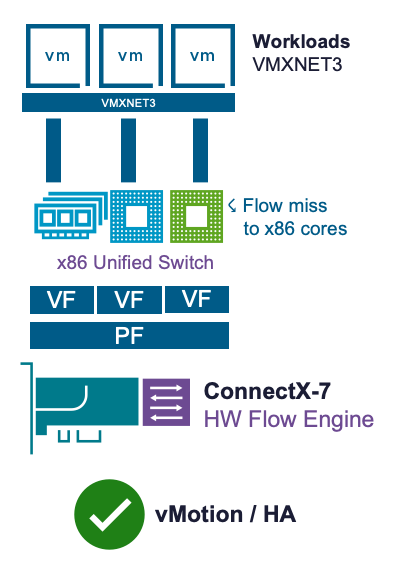
Furthermore, a key architectural distinction here is how exception handling is managed. Rather than relying on an on-card processor, Advanced NIC options route “flow misses” directly back to the host system’s robust x86 CPUs. As noted earlier, these modern options all fundamentally require the EDP Standard fastpath to function.
- Uniform Passthrough (UPT) with ConnectX-7, BlueField-2/3 (NIC):Our strongly recommended solution for Edge and other distributed workloads requiring maximum hardware performance. This modern capability provides direct passthrough performance but strategically leverages the standard VMXNET3 driver to access traditional vSphere features, unifying the high-speed data path with the hypervisor’s control plane.
- Enhanced DirectPath with ConnectX-7, BlueField-3 (NIC): Our preferred passthrough solution for AI and ML workloads. Relying on a pairing with a compatible guest driver, this option delivers best-in-class, near-native performance. It uses the new Enhanced DirectPath API framework—introduced in vSphere 8—to execute traditional vSphere features like vMotion, Live Patch, and Suspend/Resume alongside hardware-backed virtual devices, and crucially implements vMotion support for GPUDirect RDMA.
🌯 To wrap this up, understanding the network offload landscape is crucial for reaching maximum performance without sacrificing day-two manageability. In subsequent posts, we will take a deep dive into practical configurations, complete with step-by-step demos showing exactly how to deploy and configure Uniform Passthrough (UPT) and Enhanced DirectPath I/O (EDPIO) in your own environments.
In the meantime, if you want to explore the specifics of these Advanced NIC Passthrough capabilities in VCF 9.1, check out these excellent resources:
- Simplify Workload Connectivity and Enhance Network Scale and Performance with VCF 9.1 to see how these network offload modes fit into the broader VCF 9.1 networking updates.
- VMware Private AI Foundation with NVIDIA TechDocs, which details how to configure VMXNET3 with UPT support and EDPIO within your VM classes to maximize networking throughput for AI and ML nodes.
- Enhanced Network Offloads and Advanced NIC Passthrough, the official technical documentation for enabling network offloads using Advanced NIC Passthrough in VCF 9.1.
Why Enhanced DirectPath Wins for High-Performance Apps by Nick Ford, detailing the exact operational trade-offs of legacy passthrough vs modern API frameworks. Nick’s blog inspired some of what I wrote here. Thanks Nick! 🫡 - Configuring an NSX Edge Transport Node with UPT
Yours truly 🙃
~Gabe
P.S. Five years ago or so, I used to bring Henry in a kidRunner stroller to races. That same son of mine just completed his first 10K on his own two feet! He’s already asking to do a half marathon!


If you made it this far, love you 😜. See you 🔜.”

