
Visibility is the cornerstone of a secure and well-managed VMware Cloud Foundation (VCF) environment. Whether you are troubleshooting transient network issues or meeting strict compliance requirements, IPFIX (Internet Protocol Flow Information Export) is the go-to tool for deep flow analysis.
However, visibility often comes with a “performance tax.” During recent performance evaluations of VCF 9 – benchmarked against previous releases using ESXi 8.0.3 and NSX 4.1.x – we examined the overhead associated with IPFIX across various datapath configurations. Our findings indicate that Enhanced Data Path (EDP) Standard is a critical requirement for maintaining performance stability when IPFIX is enabled
The Evolution of Flow Export
When IPFIX is enabled on the ESXi datapath, the host performs extra work to track and export flow data to collectors. This overhead is typically expressed as a change in throughput or transaction rates compared to a baseline where IPFIX is disabled. In our tests, we compared three primary IPFIX application points:
- Switch IPFIX (Default VCF IPFIX template for NSX-enabled networks and switches)
- DFW IPFIX (IPFIX template for DFW-enabled networks and interfaces)
- VDS IPFIX (IPFIX template for non-NSX-enabled networks and switches)
UDP Impact: Why EDP is Essential
The most significant finding from our internal performance matrix is the massive efficiency gain provided by EDP.
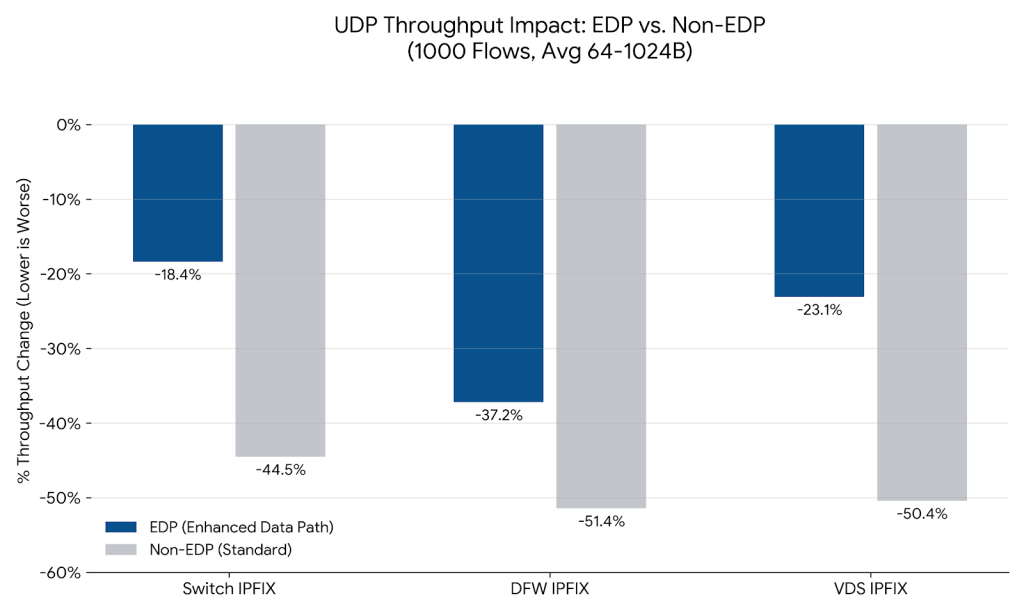
In high-stress UDP scenarios (1000 flows), standard Non-EDP paths observed a performance drop of over 50% when DFW or VDS IPFIX was enabled. By contrast, EDP Standard mitigated this impact significantly, keeping the drop as low as 18.4% for Switch IPFIX.
TCP Transactions: A Lighter Footprint
The overhead associated with IPFIX flow exports fluctuates according to the traffic profile, with a notable variance between TCP transactions and UDP flows. Our analysis demonstrates that while UDP bulk traffic generates greater strain during flow export, the performance impact on standard application traffic, such as TCP transmissions, is considerably more marginal.
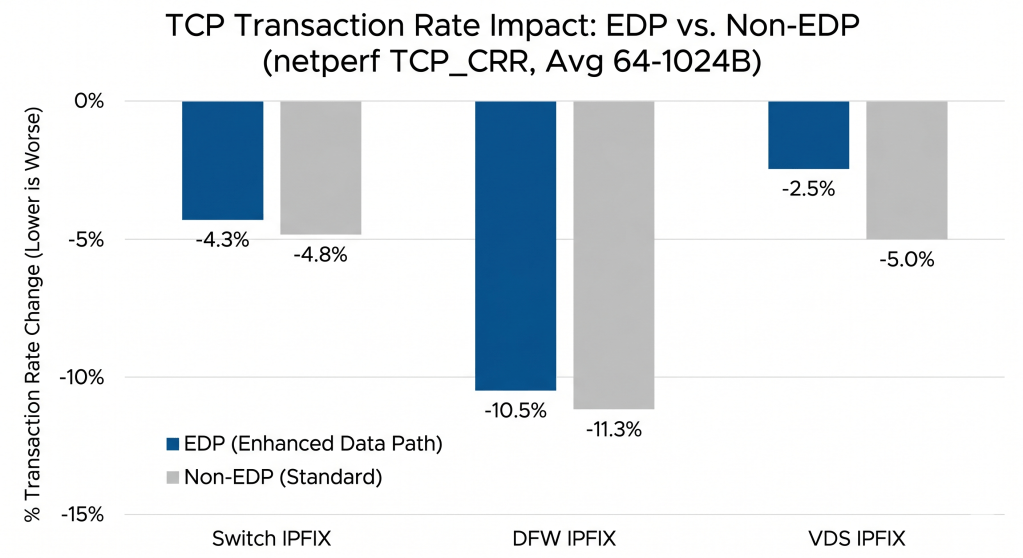
Impact on TCP Transaction Rates (TCP_CRR) generally stayed within a 2.5% to 11.3% range. Even here, EDP consistently outperformed non-EDP (Standard), ensuring that application response times remain snappy even under heavy monitoring.
Looking Ahead: VCF 9.x and the ConnTrack Advantage
The continuous optimization of the IPFIX module reflects the platform’s focus on balancing deep visibility with high-performance networking. Starting with VCF 9.0 (for Switch IPFIX) and 9.1 (for VDS IPFIX), we have implemented a new ConnTrack module. These milestones dramatically improve the efficiency of how flows are tracked, making high-fidelity monitoring more accessible than ever.
See IPFIX details in the VCF 9.1 Networking launch blog.
Core Recommendations
To ensure your environment remains both visible and fast, follow these principles:
- Lead with EDP: Always steer toward Enhanced Data Path (EDP) as the standard forwarding path for monitoring and compliance use cases.
- Upgrade to VCF 9.X: Take advantage of the new ConnTrack module to minimize the performance footprint of IPFIX.
- Validate Your Flow Count: Lab data uses synthetic tests. Always perform customer-specific validation based on your actual production traffic flows and hardware.
By moving to EDP and modern VCF releases, you can achieve the deep visibility your business requires without sacrificing the performance your applications demand.
Reference Data Source
- IPFIX Performance Data for NSX vs. No NSX (Internal Lab Data, May 2026)
Authors & Contributors

Gabe Rosas is a Product Manager on the VCF Networking team. He currently leads Enhanced Data Path, Network Performance & Network Offloads.
https://www.linkedin.com/in/gaberosas/

Ken Guo serves as a Product Manager on the VCF Networking team. He leads Network Operations and Tooling. He brings more than 18 years of expertise in computer networking across engineering and product roles.
https://www.linkedin.com/in/kenguo/
This performance analysis would not have been possible without the rigorous testing and validation conducted by the VCF Networking Engineering team. Their work ensures our architectural recommendations are backed by hard data. Thank you team!

